
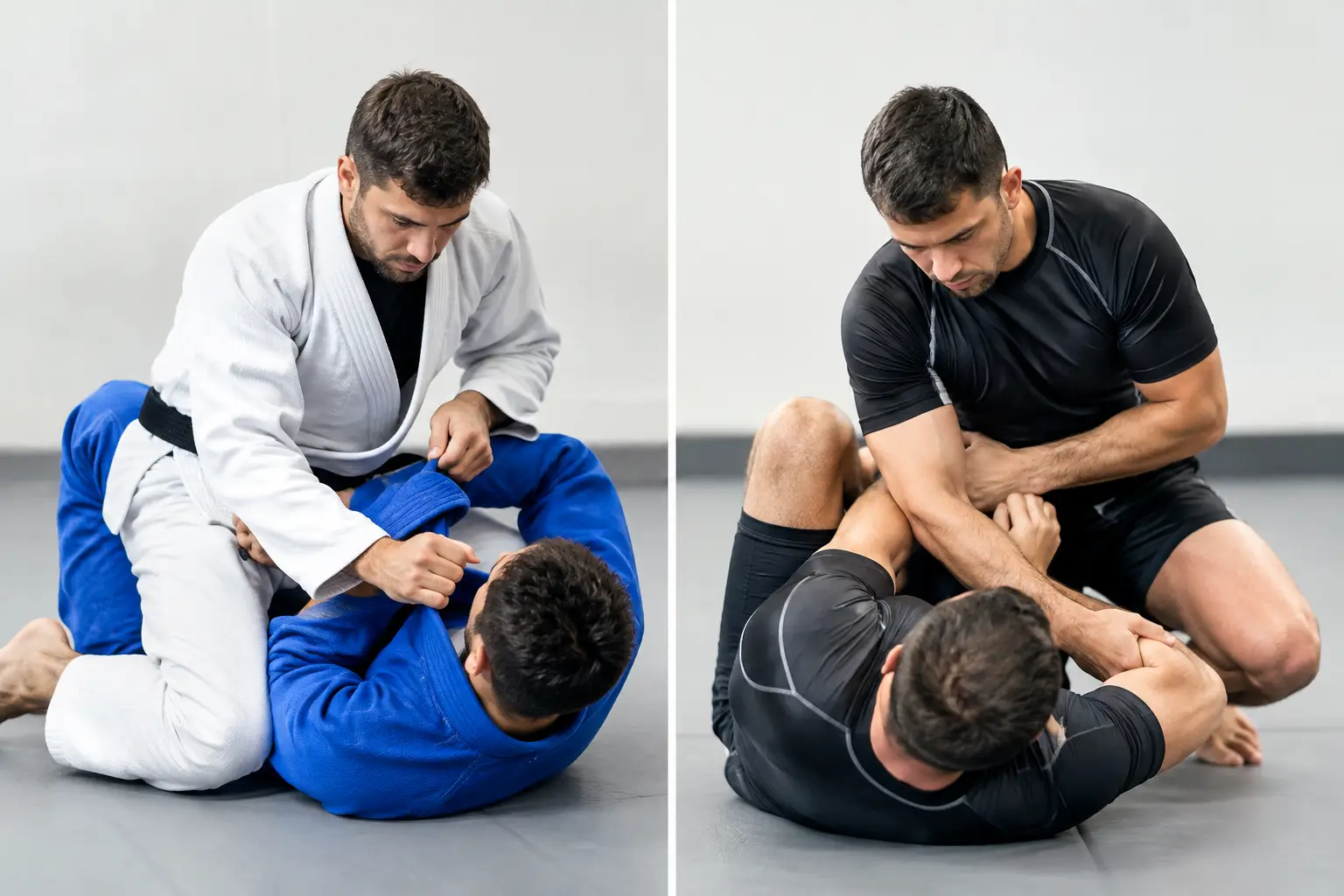
A lapel grip can slow an opponent down, set up a sweep, and create a powerful choke. Take that jacket away, and the same exchange may become a fast scramble for position. That is the heart of the Gi versus No-Gi Jiu-Jitsu differences: the uniform changes the available grips, but it also changes timing, strategy, and the problems you learn to solve under pressure.
For beginners, the question is rarely which style is better. The better question is which class supports your goals, your schedule, and the type of training experience that will keep you consistent. Both Gi and No-Gi Brazilian Jiu-Jitsu build fitness, confidence, composure, and practical grappling skill. Each simply emphasizes different parts of the game.
What Is Gi Jiu-Jitsu?
Gi Jiu-Jitsu is practiced in a traditional BJJ uniform: a durable cotton jacket, pants, and belt. The jacket and pants become part of the technical exchange. Students can grip sleeves, collars, pant legs, and the belt to control posture, limit movement, create leverage, and attack.
A Gi class often feels more methodical at first because grips give both athletes additional ways to hold and slow one another. That does not make Gi easier. It means the game has more layers. A student must learn how to establish grips, break grips, protect the neck and sleeves, and recognize how a seemingly small hand position can lead to a sweep, takedown, guard pass, or submission.
The Gi also teaches patience. If an opponent secures a strong collar-and-sleeve connection, trying to force an escape can waste energy and expose you to an attack. Learning to stay calm, frame correctly, improve position one step at a time, and make disciplined decisions is a major part of the experience.
What Is No-Gi Jiu-Jitsu?
No-Gi Jiu-Jitsu is practiced without the traditional jacket. Most students wear a fitted rash guard and shorts or spats designed for grappling. Because there are no sleeves or collars to grab, control comes from grips around the head, arms, torso, wrists, and legs, along with strong body positioning.
No-Gi often moves at a quicker pace. Opponents can slip out of loose control more easily, so transitions must be sharp and positioning must be connected. Wrestlers and athletes who enjoy fast-paced movement often feel immediately drawn to No-Gi, but beginners do not need a wrestling background to start.
The core principles remain the same: control distance, improve position, protect yourself, and use technique before strength. You will still learn takedowns, escapes, guard work, passing, pins, and submissions. The route to those positions is simply different when fabric grips are removed.
Gi versus No-Gi Jiu-Jitsu Differences on the Mat
The most obvious difference is gripping. In the Gi, a sleeve grip can prevent an opponent from posting their hand, while a collar grip can control posture and lead directly to chokes. In No-Gi, those grips do not exist. Instead, athletes use underhooks, overhooks, wrist control, collar ties, body locks, and head position to create similar control.
This changes the pace of training. Gi rounds can involve longer grip-fighting sequences and more opportunities to settle into a position. No-Gi rounds can become more mobile, especially during scrambles. Neither style is automatically more physical. A technical Gi practitioner can make someone work extremely hard with grips and pressure, while a skilled No-Gi practitioner can control a round with timing and positioning rather than speed alone.
The submission choices differ as well. Gi training features collar chokes and attacks that use the opponent's jacket. No-Gi removes those options and places more emphasis on chokes such as the rear naked choke, guillotines, and arm triangle variations, as well as joint locks. Leg locks are also more visible in modern No-Gi competition, though responsible instruction, class level, and rule set should always determine what is practiced.
Guard strategy changes too. Some Gi guards rely heavily on sleeves, collars, and pant grips to control distance. No-Gi guards tend to depend more on hooks, hip movement, clinching, and controlling the legs or upper body. The principles transfer, but a technique that works beautifully with a sleeve grip may need a different setup without it.
Which Style Is Better for Self-Defense?
Both styles offer valuable self-defense benefits because both teach the most important skill in an unwanted physical encounter: staying composed while another person is resisting. You learn how to manage distance, avoid being pinned, stand up safely, control someone without unnecessary harm, and make decisions while tired and under pressure.
Gi training has a practical advantage in many everyday situations because people commonly wear shirts, jackets, hoodies, or other clothing that can be grabbed. It teaches students how fabric can be used to control posture or create space. It also teaches them what happens when someone grips their clothing.
No-Gi training is equally useful for developing clinch control, takedown defense, body locks, and escapes when there is little or no clothing to hold. It can feel closer to situations involving athletic wear, swimwear, or an opponent without a jacket.
Still, self-defense is not a contest between uniforms. Awareness, avoidance, verbal boundaries, and the ability to disengage matter most. Jiu-Jitsu gives students physical options when avoidance fails, but good judgment remains the first line of defense.
Competition Rules Create Different Games
Competition can make Gi and No-Gi feel even farther apart. Gi tournaments often reward athletes who can use grips to control pace, score sweeps, and apply collar-based attacks. No-Gi events usually favor athletes with strong wrestling, fast transitions, and effective leg-entanglement awareness.
Rules vary significantly between organizations. Some No-Gi divisions restrict certain leg attacks based on age, experience, or belt level. Gi competitions may have specific rules about reaping, grips, stalling, and uniform requirements. Competitors need to train for the rules they will face, not just the techniques they enjoy most.
For aspiring competitors, training both can be a major advantage. Gi develops precision, grip awareness, and patience. No-Gi develops movement, wrestling connections, and the ability to maintain control without fabric. A well-rounded athlete learns to adapt instead of depending on one familiar set of grips.
What Should Beginners Choose?
Start with the class you are most likely to attend consistently. That answer may sound simple, but consistency creates the real transformation. A beginner who trains two or three times each week will build far more skill and confidence than someone who waits for the perfect style before stepping on the mat.
Choose Gi if you enjoy a technical, detail-rich approach and want to learn traditional BJJ grips, controls, and collar attacks. Many beginners appreciate the slightly slower pace because it gives them time to recognize positions and think through their next move.
Choose No-Gi if you are drawn to wrestling-style movement, quicker transitions, and a more streamlined uniform. It can be especially appealing for people who want a strong conditioning challenge or who already enjoy grappling, football, wrestling, or other contact sports.
For children, the right choice should reflect age, maturity, and the academy's curriculum. Young students benefit most from safe coaching, clear structure, positive discipline, and instruction that builds confidence without overwhelming them. The uniform matters less than the quality of the teaching and the consistency of the environment.
At Winners Jiu-Jitsu Academy, students can develop their game through both formats while receiving guidance appropriate to their experience and goals. A first-time student does not need to arrive in shape, know the terminology, or choose a competitive path on day one. They need a place to learn safely, ask questions, and improve one class at a time.
Training Both Builds a More Complete Game
There is no need to treat Gi and No-Gi as opposing teams. Each can sharpen the other. Gi grips teach students how to create and break control with purpose. No-Gi exposes weak connections quickly, demanding better balance, pressure, and transitions. When a student trains both, they become harder to surprise and more capable of adapting to different opponents.
Your preference may also change over time. A student may begin in the Gi to understand the structure of positions, then grow to love the athletic pace of No-Gi. Another may start with No-Gi and later discover the strategic depth of grip fighting. Progress does not require loyalty to one uniform. It requires the discipline to keep learning when training becomes challenging.
The best class is the one that gives you a reason to return: ready to work, willing to be coached, and proud of the person you are becoming beyond the mat.