
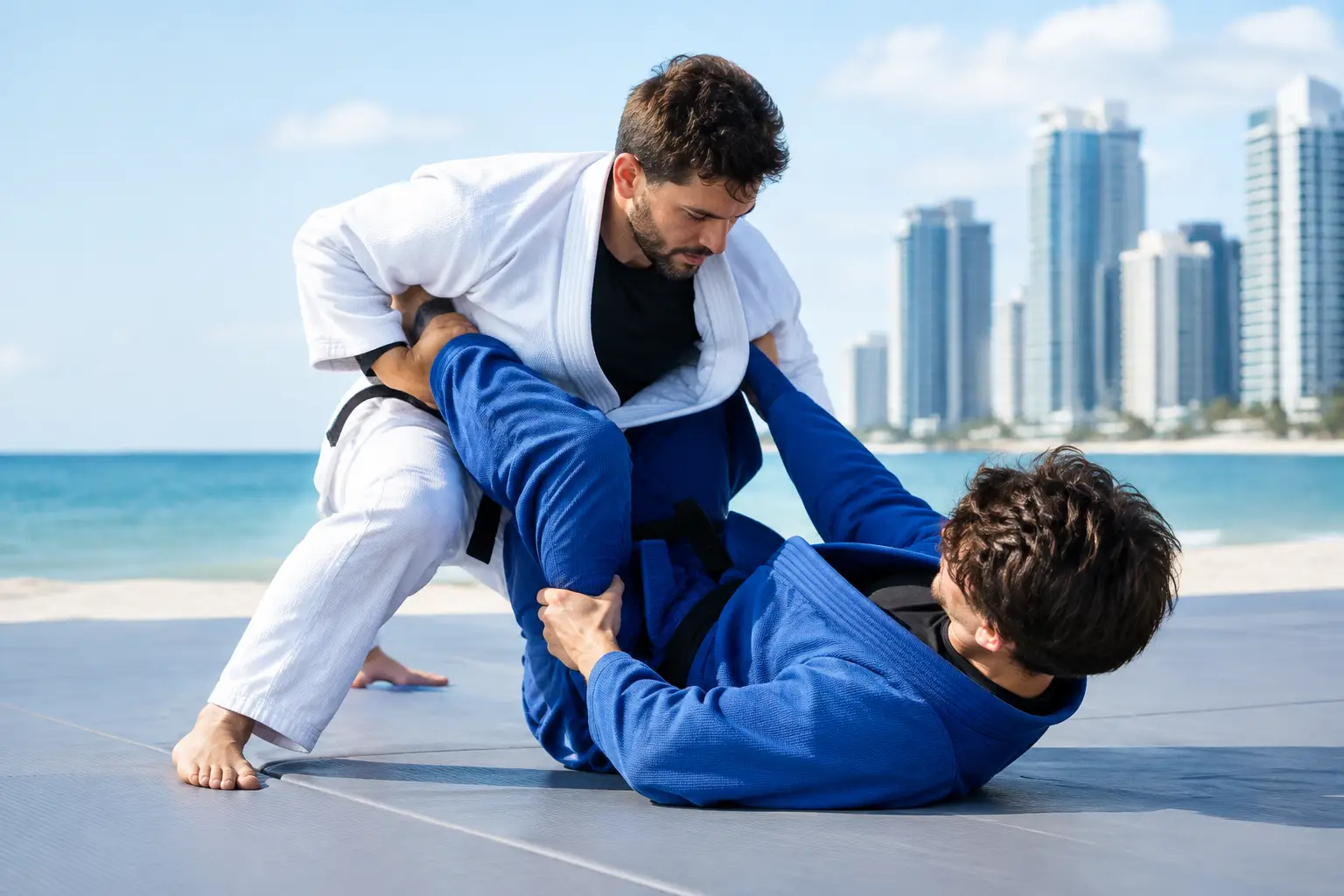
For families searching Brazilian Jiu-Jitsu Sunny Isles Beach options, the right academy should offer more than a hard workout. It should give children a place to build confidence, adults a disciplined way to challenge themselves, and serious athletes coaching that stands up to competition. The best training environment meets students where they are, then asks them to rise.
Brazilian Jiu-Jitsu is built around leverage, timing, position, and calm problem-solving. A smaller person can learn to control a larger, stronger opponent by using technique instead of panic or raw force. That principle is why BJJ appeals to so many people across Sunny Isles Beach: parents looking for a constructive activity, professionals seeking stress relief, beginners who want practical self-defense, and competitors pursuing high-level goals.
Why Brazilian Jiu-Jitsu Fits Sunny Isles Beach Families
Sunny Isles Beach is active, international, and family-oriented. Parents want programs that keep kids moving but also teach them how to listen, persevere, and handle difficult moments with maturity. Adults often want fitness that feels purposeful, not another routine they will abandon after a few weeks.
Jiu-Jitsu creates that purpose. Every class presents small, solvable challenges: maintaining balance, escaping a difficult position, remembering a sequence, or staying composed during a live round. Progress is earned through repetition. Students see that steady effort produces visible results, whether that means a child speaking up with more confidence or an adult successfully applying a technique against a resisting partner.
Unlike training that depends only on speed or athleticism, BJJ gives students a long runway for growth. A beginner can make meaningful progress quickly, while advanced practitioners can spend years refining details. That makes it a sustainable practice for people who want more from exercise than a temporary burst of motivation.
What Adults Can Expect From Their First Class
Many adults delay starting because they believe everyone else will be younger, fitter, or far more experienced. The reality is that every skilled practitioner began as a beginner. A well-organized adult program introduces fundamentals in a structured, welcoming setting rather than dropping new students into intense sparring without preparation.
Your first Brazilian Jiu-Jitsu class will usually begin with movement and warm-up drills designed to prepare the body for training. You may learn how to fall safely, move from the ground, establish a stable position, or escape from underneath an opponent. Then you will practice the technique with a partner, slowly and with coaching.
Live training, often called rolling, is an important part of BJJ, but it should match your experience level. Beginners do not need to prove anything on day one. Good training partners control their pace, and qualified instructors create an environment where safety and learning come before ego.
The physical benefits are real. Jiu-Jitsu develops grip strength, mobility, cardiovascular conditioning, coordination, and functional core strength. But many adults stay because of the mental return. Training requires full attention, giving busy professionals a break from emails, deadlines, and constant distractions. When you are focused on position and breathing, the rest of the day gets quieter.
How Often Should Adults Train?
For most beginners, two classes per week is enough to create momentum without overwhelming the body or schedule. Three sessions per week can accelerate improvement for students who recover well and want a stronger fitness routine. Training once a week is still better than waiting for the perfect schedule, but consistency matters more when learning technical movement.
There is no prize for training through pain. Soreness is normal when you start a new activity; sharp pain, joint instability, or ongoing discomfort deserves attention. Smart progress includes recovery, good sleep, hydration, and communicating with your instructor when something does not feel right.
Jiu-Jitsu for Kids: More Than an After-School Activity
Children do not need a background in sports to begin Jiu-Jitsu. In fact, the mat can be especially valuable for kids who are shy, easily frustrated, highly energetic, or still learning how to work with others. They learn to follow instructions, take turns, manage physical space, and keep trying when a skill does not work immediately.
Age-specific instruction matters. A 3- or 4-year-old needs games, movement, simple coordination, and clear routines. Children ages 5 to 7 can begin developing stronger focus, listening skills, and basic technique. Students ages 8 to 12 are ready for greater technical detail, goal-setting, partner responsibility, and more structured training.
The goal is not to make every child a competitor. It is to help each child become more capable. Through controlled drills and supervised sparring, children gain a realistic understanding of balance, distance, and self-protection. They also learn that strength does not give someone permission to intimidate others.
For parents concerned about bullying, Jiu-Jitsu offers a healthier message than simply telling a child to fight back. Kids learn awareness, boundary-setting, de-escalation, and how to protect themselves if they cannot walk away. Just as importantly, they learn self-respect. A child who feels capable is often less likely to be targeted and less likely to react from fear.
Choosing a Brazilian Jiu-Jitsu Academy in Sunny Isles Beach
Not every martial arts program offers the same experience. Location and schedule matter, especially for busy families, but they should not be the only deciding factors. Look closely at how the academy teaches beginners, supervises children, and manages live training.
Coaching credentials are also worth considering. Elite competitive experience does not automatically make someone a great instructor, but it can bring valuable technical depth when paired with a clear teaching system. Students who want to compete should have access to coaches who understand preparation, strategy, conditioning, and the demands of tournament day. Beginners should receive the same respect and attention as the most experienced athletes in the room.
The academy culture matters just as much. A serious room can be demanding without being reckless. You should see students helping one another, instructors correcting technique with patience, and clear expectations around cleanliness, respect, and safety. The strongest teams are not built on intimidation. They are built on accountability and shared standards.
At Winners Jiu-Jitsu Academy, students train under the guidance of two-time World Champion Jonatas Gurgel in programs designed for young children, school-age kids, adults, beginners, advanced practitioners, and competitors. The focus is not simply on collecting techniques. It is on building students who can think clearly under pressure and carry themselves with confidence on and off the mat.
Gi, No-Gi, and Self-Defense Training
New students often ask whether they should begin with Gi or No-Gi Jiu-Jitsu. The answer depends on their goals, but both are valuable. Gi training uses the traditional uniform and teaches grips, posture, control, and patience. The fabric creates more connection between partners, which often helps students understand leverage and positional detail.
No-Gi training is performed without the traditional jacket and emphasizes underhooks, body control, wrestling-style movement, and faster transitions. It can feel more athletic and dynamic, especially for students interested in grappling competition or mixed martial arts. Neither format is automatically better. Training both can give a student a more complete understanding of Jiu-Jitsu.
Self-defense training adds another layer by addressing awareness, distance, standing control, and practical responses to common threats. The goal is never to seek conflict. Real self-defense begins with recognizing danger early, creating space, and leaving safely whenever possible. Physical technique is there for the moment when avoidance is no longer available.
Progress Is Built One Class at a Time
Belt progression is meaningful in Brazilian Jiu-Jitsu because it reflects more than attendance. Students are developing technical understanding, consistency, composure, and the ability to apply what they learn against resistance. The timeline is different for everyone. A parent balancing work and family may progress at a different pace than a student training several times a week for competition.
That is not a weakness. The most valuable comparison is not with the person beside you, but with the version of yourself who walked in for the first time. Over weeks and months, the changes become clear: better posture, improved energy, more patience under pressure, and the confidence to face a hard round or a hard day without backing down.
If you are considering Brazilian Jiu-Jitsu, do not wait until you feel perfectly fit, fearless, or fully prepared. The mat is where those qualities are built. A free trial class can give you or your child a firsthand sense of the coaching, community, and challenge that turn a first step into a lasting habit.