
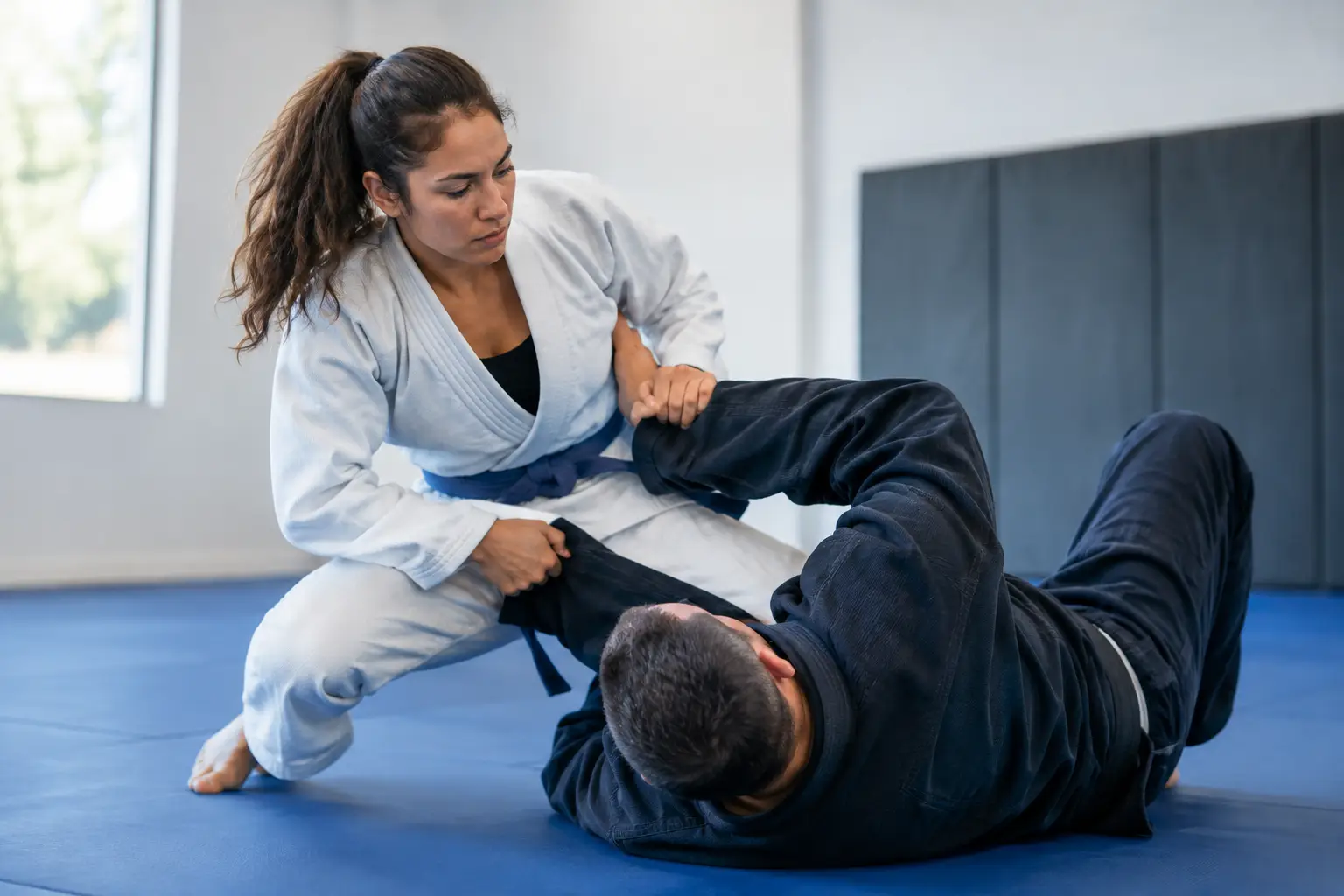
A confrontation rarely begins with a clean punch from across the room. More often, it starts too close: someone grabs a wrist, blocks a doorway, pushes, crowds, or tries to pull you off balance. That is where Brazilian Jiu-Jitsu for self defense has real value. It teaches you how to stay composed when another person is close enough to control your movement - and how to create the space needed to get home safely.
Brazilian Jiu-Jitsu is not about looking for a fight or proving toughness. Its purpose is control. Students learn how to manage distance, protect themselves during a fall, escape holds, improve position, and restrain an aggressor when escape is not immediately available. For adults, that can mean more confidence during uncertain moments. For children, it can mean stronger boundaries, better anti-bullying awareness, and the discipline to seek help rather than escalate.
Why Brazilian Jiu-Jitsu for Self Defense Works
Size, strength, and aggression matter in a physical encounter. Pretending otherwise is not responsible instruction. What makes Jiu-Jitsu valuable is that it gives a smaller or less powerful person technical options when strength alone is not enough.
The art focuses on leverage, balance, timing, and body positioning. Instead of meeting force with more force, a trained student learns to redirect pressure, protect vulnerable areas, and use efficient movement. If someone grabs your clothing, wraps their arms around you, or takes you to the ground, Jiu-Jitsu offers a practical framework for surviving the position and working toward escape.
This is especially relevant because many real altercations become clinches. People grab, shove, stumble, and hold on. A student who has trained repeatedly with resistance is less likely to panic when personal space disappears. They have felt pressure before. They understand how to breathe, frame, move their hips, and make decisions one step at a time.
That calm is one of the most meaningful benefits. Good self-defense is not just knowing a technique. It is being able to think while your heart rate rises.
Control Is Better Than Escalation
Many martial arts students begin with a simple goal: they want to feel safer. Over time, they often discover that safety is not always about hurting another person. In many situations, the best outcome is controlling someone long enough to disengage, protect a child or family member, or wait for help.
Jiu-Jitsu gives students tools for that middle ground. A person may need to break a grip and leave. They may need to keep an aggressive person from standing up. They may need to maintain distance without throwing a strike. Those choices can matter in a crowded place, a workplace conflict, or a situation involving someone you know.
Training also reinforces restraint. Sparring teaches students that a hard round can be handled without anger and that tapping is a sign of awareness, not weakness. Students learn to respect pressure, recognize danger, and stop when appropriate. Those are habits that carry beyond the mat.
The Ground Is a Reality, Not a Destination
Brazilian Jiu-Jitsu is well known for ground fighting, and that creates a fair question: is going to the ground safe in a real-world situation?
Usually, staying on your feet and leaving is the better option. Concrete is unforgiving. A fall can cause serious injury, and the ground is a dangerous place if there are multiple attackers, weapons, traffic, or hard surfaces nearby. No responsible instructor should tell students to pull guard during a parking lot confrontation.
The value of ground training is not that students should choose the ground. It is that they are better prepared if they end up there. A person who has never practiced underneath another person’s weight may freeze. A trained student has a map: protect the head, control space, avoid being pinned, recover a stronger position, stand safely, and escape.
The same principle applies to takedowns. Self-defense-focused Jiu-Jitsu should include balance, grip fighting, clinch awareness, and safe breakfalls. You do not need to become an elite wrestler to benefit from knowing how not to be easily knocked down.
Sport Jiu-Jitsu and Self Defense Are Related, But Different
Sport Jiu-Jitsu builds valuable attributes. It develops timing, endurance, positional awareness, discipline, and the ability to solve problems against a resisting partner. Competitive training can sharpen a student quickly because the pressure is real and measurable.
Still, sport rules are not the street. A tournament has a referee, a defined space, a single opponent, and rules against striking. Self-defense training must account for awareness, verbal boundaries, escape routes, standing up safely, and the possibility that an aggressor may strike or have friends nearby.
The strongest programs do not treat these as opposing worlds. They use live training to build real skill, then teach students how to adapt that skill to safer self-defense priorities. At Winners Jiu-Jitsu Academy, students can develop both technical depth and practical judgment in a structured, supportive environment.
What Jiu-Jitsu Cannot Promise
A good academy should be honest about the limits of any martial art. Brazilian Jiu-Jitsu does not make someone invincible. It cannot guarantee safety against a weapon, multiple attackers, a surprise attack, or a much larger and determined opponent.
That does not make training less worthwhile. It makes the goal clearer. Self-defense begins well before physical contact. Awareness, avoiding isolated areas, trusting your instincts, keeping distance, using your voice, and leaving early are all powerful skills. Physical techniques are the last layer, not the first one.
Students should also understand that simple techniques practiced consistently are more reliable than complicated moves remembered from a single seminar. Under stress, fine details can disappear. Training needs repetition, progressive resistance, and coaching that helps students understand when a technique is appropriate.
What Beginners Should Expect From Training
The first class is not a test of athleticism. Beginners do not need experience, flexibility, or perfect fitness to start. They need the willingness to learn and a place where training partners are expected to be respectful.
A quality beginner program starts with fundamentals: posture, movement, base, balance, breakfalls, escapes, and safe partner drills. Students gradually learn how to work from common positions and how to apply techniques without relying on speed or brute strength. Controlled sparring, introduced at the right pace, helps those movements become useful under pressure.
Adults often notice physical changes first. They sleep better, move better, gain conditioning, and find a productive outlet for stress. The deeper change is confidence. Not loud confidence. Quiet confidence built through showing up, learning difficult skills, and discovering that pressure can be managed.
For children, the benefits are equally practical. Kids learn to listen, follow structure, respect personal space, and respond to conflict with judgment. A child who trains does not need to become aggressive to become harder to intimidate. They can stand taller, speak more clearly, and understand that asking an adult for help is part of being strong.
How Often Should You Train for Real Progress?
For most beginners, two classes per week is enough to build a meaningful foundation. It creates consistency without overwhelming a busy work or family schedule. Three or more classes per week can accelerate conditioning and technical development, especially for students with competitive goals.
Progress is not only measured by belts or submissions. It may look like staying calm during a difficult round, escaping a position that once felt impossible, or walking into class after a long day with the discipline to keep improving. The students who make the most lasting gains are rarely the ones chasing a fast result. They are the ones who train consistently and let confidence compound.
Brazilian Jiu-Jitsu for self defense is most effective when it is taught with honesty: avoid trouble when possible, escape when you can, and use control when there is no better option. The mat is a place to build the composure, discipline, and practical skill that help you make better choices when pressure arrives. Start at your own pace, train with intention, and let each class strengthen the person you are becoming.