
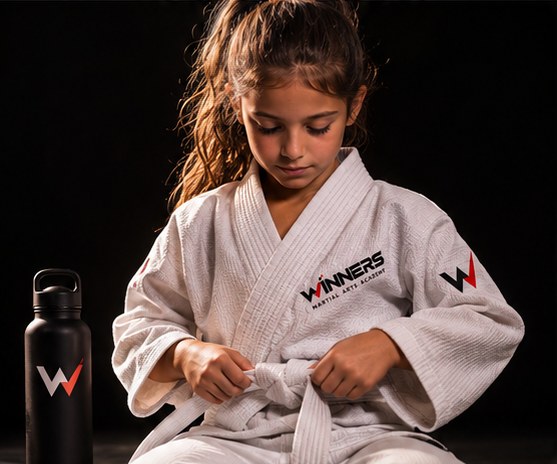
Being a good training partner teaches kids teamwork in a very direct way: they can't practice a single technique without someone else, so they learn to respect that person, keep them safe, and handle winning and losing with grace. In Kids Jiu-Jitsu, every drill is a small team project. Those habits show up later in how kids treat classmates, siblings and friends.
For parents in Golden Beach looking for an activity that builds character as well as fitness, this is one of the most useful things jiu-jitsu offers. Here's what it looks like in practice.
Why Jiu-Jitsu Can't Be Learned Alone
Some sports let a child improve by practicing alone in the backyard. Jiu-jitsu doesn't work that way. To learn an escape, your child needs a partner who holds the position. To learn a sweep, they need a partner who lets them try it, again and again.
That means every kid on the mat depends on the others. If your partner is careless, you don't learn. If your partner is helpful, you both get better. Kids figure this out quickly, and it changes how they act.
Four Things a Good Training Partner Learns
1. Respect Comes First
Respect on the mat is not a speech. It's small, repeated actions: listening when the coach talks, waiting your turn, working with whoever you're paired with, even if it's not your best friend.
Kids get paired with different classmates: bigger, smaller, newer, more experienced. Learning to work well with all of them is real teamwork, the same skill they need on a school project or a sports team.
2. Taking Care of Your Partner
In jiu-jitsu, when a partner taps, you let go. Right away, every time. That simple rule teaches kids that someone else's safety matters more than "winning" a drill.
A good partner also learns to:
- Go slowly when the other kid is learning something new
- Use control instead of strength
- Pay attention to younger or smaller partners
- Speak up and tell the coach if something doesn't feel right
These are the same instincts that make a child a good friend: noticing how the other person is doing and adjusting.
3. Letting Your Partner Succeed
This one surprises parents. During drills, part of your child's job is to let their partner do the technique. They give a little resistance, but not so much that the partner can't learn.
For a competitive kid, this is a big lesson. Helping someone else succeed is part of how you succeed. The partner you help today is the one who helps you tomorrow.
4. Winning and Losing Well
At the end of class, kids practice controlled sparring. Sometimes they come out on top. Sometimes they get stuck on the bottom the whole round. Both happen to everyone, including the coaches when they were kids.
A good training partner learns to shake hands after a tough round, say "good job" when someone catches them, and not gloat when they do well. Losing a round on the mat is low stakes, which makes it a great place to practice handling disappointment.
What Partner Work Looks Like in a Real Class
Every jiu-jitsu class at the academy has three parts, and teamwork shows up in each one:
- Warm-up: coordination, technical movement drills and conditioning. Kids move together as a group and follow the same instructions.
- Technique and drills: the coach shows a move, then kids pair up and take turns. One practices, the other helps.
- Technical and situational sparring: kids start from a specific position and try to accomplish a goal, like escaping or holding position, with a partner trying to stop them.
A child in a 45 or 50 minute class may work with several partners. That's a lot of small chances to practice patience, cooperation and self-control.
The In-House Competition: Sportsmanship With a Safety Net
Three times a year, Winners holds an in-house competition at the academy. It's designed as a safe first competition, in a familiar room with familiar coaches.
This is where the lessons above get tested. Kids step on the mat with a little more pressure. They might win a match, lose one, or both in the same day. Coaches and parents get to see whether the habits from class hold up: shaking hands, respecting the result, cheering for teammates.
For many kids, the most valuable moment isn't a win. It's walking off the mat after a loss, high-fiving the other child and going back to sit with their team.
How the Character Program Backs It Up
The kids program focuses on one virtue each month: Discipline, Courage, Respect, Resilience, Anti-Bullying and Health Habits. Respect and Resilience connect directly to being a good partner.
Once a month, kids bring home a one-page homework with four questions about the virtue. It's quick, it isn't extra work for parents, and it counts toward the next belt. It gives you an easy opening to talk with your child about how they treat others.
Kids can also earn a stripe each month, and belt ceremonies happen twice a year. Showing up, trying hard and being a good partner are part of what moves them forward.
What Parents Can Do at Home
You don't need to know jiu-jitsu to support this. A few simple ideas:
- Ask about partners, not just results. "Who did you train with today? Did you help them?"
- Praise effort and kindness. Notice when your child talks about helping a newer kid.
- Normalize tough rounds. "Getting stuck is how you learn" goes a long way.
- Use the monthly homework. It's a ready-made conversation about values.
Training Near Golden Beach: Kids Jiu-Jitsu in Sunny Isles Beach
Winners Training Center is nearby in Sunny Isles Beach at 17100 Collins Ave, Unit 201, and families from Aventura, North Miami Beach, Bal Harbour and Golden Beach train with us. You can learn more on our Jiu-Jitsu near Golden Beach page.
Kids are grouped by age, so partners are at a similar stage:
- Ages 3-4 (45 min): Monday and Wednesday at 4:15 PM, Tuesday and Thursday at 5:00 PM
- Ages 5-7 (45 min): Monday to Friday at 5:00 PM
- Ages 8-12 (50 min): Monday to Friday at 5:50 PM
- Ages 6-12 (60 min): Saturday at 10:00 AM
Kids ages 8-12 can also combine Kids Jiu-Jitsu with Kids Kickboxing, which uses controlled partner drills too.
How a Kid's Week Might Look
A 6-year-old might train Tuesday and Thursday at 5:00 PM, then join the Saturday 10:00 AM class. A 10-year-old could come Monday, Wednesday and Friday at 5:50 PM. Missed classes can be made up at another time, so a busy school week doesn't mean falling behind.
What the First Class Looks Like
- Arrive 10 minutes early and sign the waiver (online or at the front desk).
- Bring water and flip-flops. We lend the gi for free.
- The front desk welcomes you and introduces the coach.
- You can watch from outside the mat while your child trains.
- After class, the coach shares feedback and the front desk explains the plans.
Free trials run on weekdays. There are no free trial classes on Saturday.
Try a Class and See the Teamwork for Yourself
The best way to understand what a good training partner looks like is to watch a class. Your child's first class is a free trial, and our coaches will make sure they're paired with someone who helps them feel welcome. Book your free trial class here.